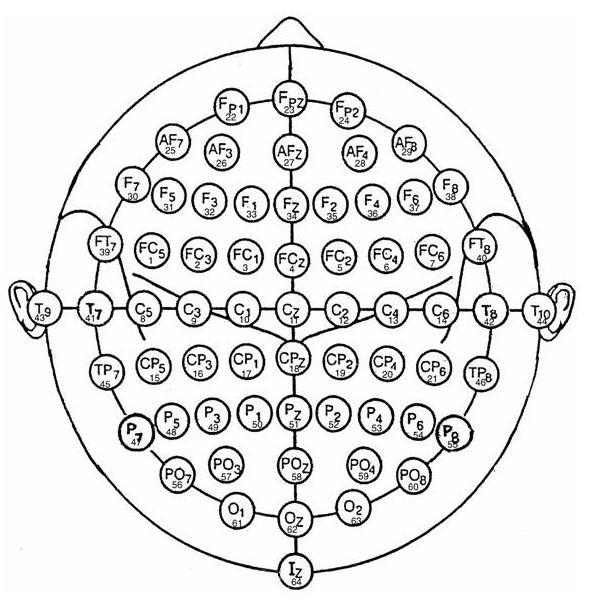
| Description: | This data set was provided by Fraunhofer-FIRST, Intelligent Data Analysis Group (Klaus-Robert Muller), and Freie Universitat Berlin, Department of Neurology, Neurophysics Group (Gabriel Curio) Correspondence to Benjamin Blankertz for the BCI II competition (Data set IV).
This dataset was recorded from a normal subject during a no-feedback session. The subject sat in a normal chair, relaxed arms resting on the table, fingers in the standard typing position at the computer keyboard. The task was to press with the index and little fingers the corresponding keys in a self-chosen order and timing 'self-paced key typing'. There are two classes: 0 for upcoming left hand movements and 1 for upcoming right hand movements. The experiment consisted of 3 sessions of 6 minutes each. All sessions were conducted on the same day with some minutes break in between. Typing was done at an average speed of 1 key per second. There are 316 train cases and 100 test cases. Each case is a recording of 28 EEG channels of 500 ms length each ending 130 ms before a keypress. This is downsampled at 100 Hz (as recommended) so each channel consists of 50 observations. Channels are in the following order: (F3, F1, Fz, F2, F4, FC5, FC3, FC1, FCz, FC2, FC4, FC6, C5, C3, C1, Cz, C2, C4, C6, CP5, CP3, CP1, CPz, CP2, CP4, CP6, O1, O2). The recording was made using a NeuroScan amplifier and a Ag/AgCl electrode cap from ECI. 28 EEG channels were measured at positions of the international 10/20-system (F, FC, C, and CP rows and O1, O2). Signals were recorded at 1000 Hz with a band-pass filter between 0.05 and 200 Hz.
The winning entry achieved an error rate of 16\% using 3 features from combination of common subspace decomposition and Fisher discriminant, and classification with a perceptron neural network.
References Benjamin Blankertz, Gabriel Curio and Klaus-Robert Muller, Classifying Single Trial EEG: Towards Brain Computer Interfacing, In: T. G. Diettrich and S. Becker and Z. Ghahramani (eds.), Advances in Neural Inf. Proc. Systems 14 (NIPS), 2002. |