| Description: | The data set was part of the BCI IV competition, data set 3. Contains directionally modulated MEG activity that was recorded while subjects performed wrist movements in four different directions.
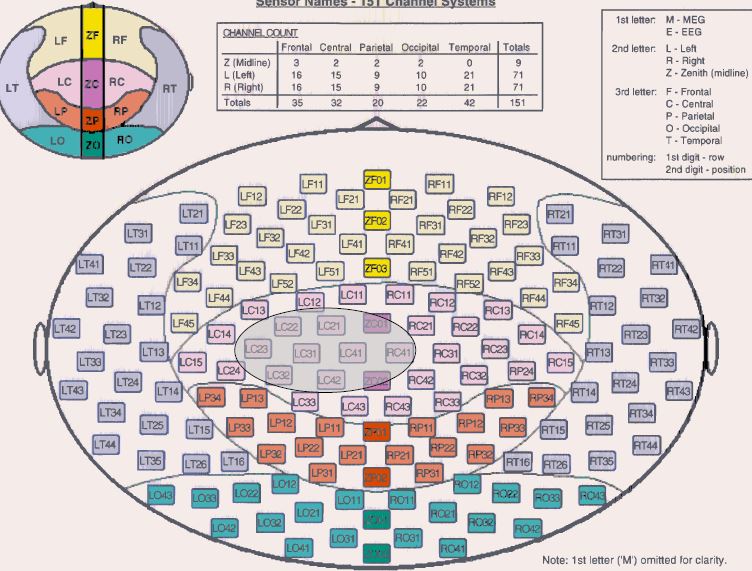
Brain activity during wrist movements was recorded with MEG at 625 Hz from two healthy, right-handed subjects. The subject sat relaxed in an MEG chair, the elbow rested on a pillow to prevent upper arm and shoulder movements, and the head was stabilized by small pillows. The task was to move a joystick from a center position toward one of four targets located radially at 90 degrees intervals (four-class center-out paradigm) using exclusively the right hand and wrist. Movement amplitude was 4.5 cm. In each trial, the target was self-chosen by the subject. Targets were arranged in the form of a rhombus in the horizontal plane with corners pointing left, right, away from and toward the subject's body. Visual trigger signals were presented on a screen to start a trial or to indicate possible time violations. A trial started with the joystick in the center position and the appearance of a gray circle. After a variable delay (1-2 s), the disappearance of the circle indicated the go signal (cued movements). Then, within 0.75 s the subject had to start the movement and reach the target. For a trial to be valid, the subject also had to rest at the target for at least 1 s. These time constraints allowed for temporal consistency across trails and the hold period at the target prevented interference of in- and outward movements. A red cross was presented continuously for fixation. The trials were cut to contain data from 0.4 s before to 0.6 s after movement onset and the signals were band pass filtered (0.5 to 100 Hz) and resampled at 400 Hz. Hence, each series is of length 500. There are 10 series per case from ten MEG channels which were located above the motor areas. Please note that classification using cross-validation on the provided training data does not necessarily yield the average decoding accuracy reported in our original study because of the reduced number of channels (approx. one quarter), inter-subject variability and the reduced number of trials in the training set due to separation of data into training and test set.
This data is just for test suibject 1 in the same train test split as in the competition
|